
Hiring foreign employees in Singapore starts with choosing the right work pass. The two most common options are the Employment Pass (EP) and the S Pass, but each is designed for different types of employees and business needs.
This guide explains the key differences between the Employment Pass and S Pass, helping employers understand which work pass may be more suitable for their hiring requirements.
What Are the Employment Pass and S Pass?
The Employment Pass (EP) and S Pass are the two primary work passes used by employers to hire foreign employees in Singapore.
The Employment Pass is generally intended for professionals, managers, executives, and specialists, while the S Pass is designed for skilled technical and operational employees. The appropriate work pass depends on factors such as the candidate’s qualifications, salary, job responsibilities, and the employer’s workforce profile.
Employment Pass vs S Pass: Key Differences
The table below covers all the criteria that matter when deciding which pass to apply for. All figures are based on MOM’s current 2026 requirements.
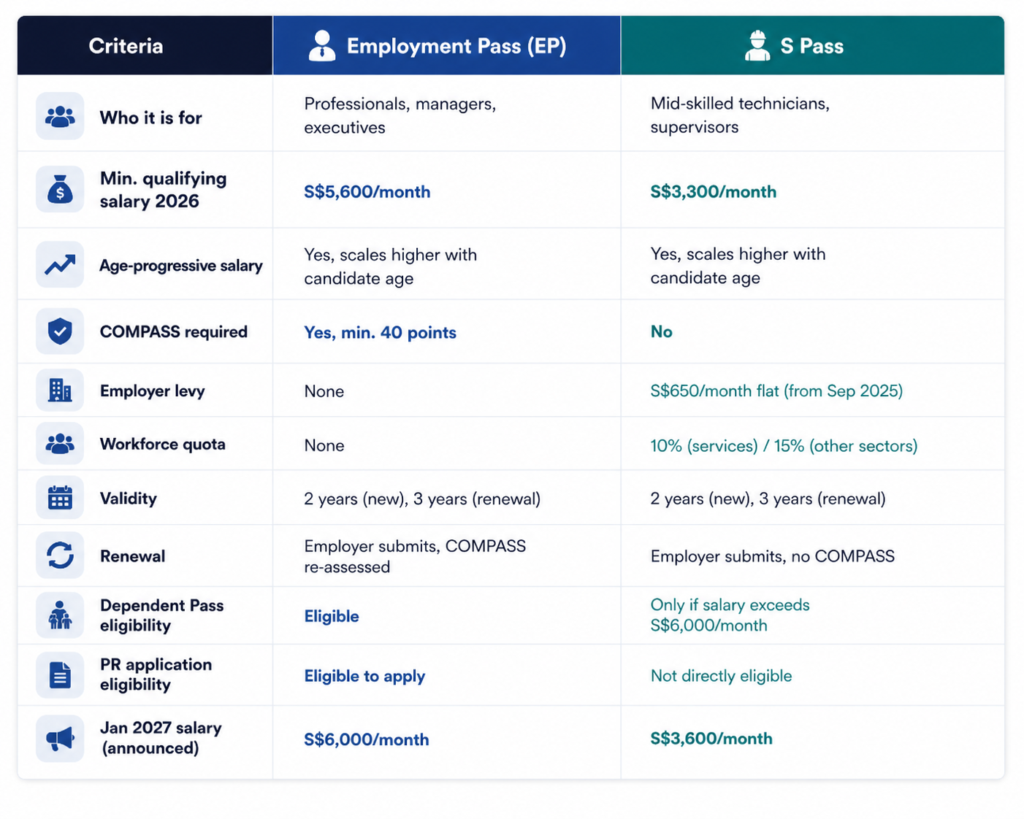
While both work passes allow foreign employees to work in Singapore, the most appropriate option depends on the candidate’s qualifications, salary, job responsibilities, and your company’s hiring needs.
Salary Requirements
Both the Employment Pass and S Pass have minimum salary requirements set by the Ministry of Manpower (MOM). The applicable qualifying salary varies according to factors such as the candidate’s age and experience and is reviewed periodically.
Employers should always refer to the latest MOM requirements when assessing a candidate’s eligibility.
COMPASS Assessment
Employment Pass applications are assessed under the Complementarity Assessment Framework (COMPASS), which evaluates factors beyond salary, including the candidate’s profile and the employer’s workforce characteristics.
S Pass applications are not subject to the COMPASS framework, making this one of the key distinctions between the two work passes.
Quota and Levy
Unlike the Employment Pass, S Pass applications are subject to quota and levy requirements. Employers should consider their available S Pass quota and applicable levy obligations before proceeding with an application.
Validity and Renewal
Both the Employment Pass and S Pass are issued for a specified validity period and may be renewed, subject to the prevailing Ministry of Manpower (MOM) requirements.
Employers should submit renewal applications before the pass expires to ensure employees remain authorised to work in Singapore.
Which Work Pass Should Employers Choose?

Choosing between an Employment Pass and an S Pass depends on several factors, including:
- Nature of the role
- Candidate’s qualifications
- Proposed salary
- Company workforce profile
- Available S Pass quota
- Long-term hiring plans
Generally, the Employment Pass is more suitable for professional and managerial positions, while the S Pass is commonly used for skilled technical and operational roles.
When evaluating a candidate, employers should consider the overall role and business requirements rather than focusing on salary alone.
Frequently Asked Questions (FAQ)
Which is easier to obtain: an Employment Pass or an S Pass?
Neither work pass is inherently easier to obtain. Each has its own eligibility requirements and assessment criteria. The appropriate work pass depends on the candidate’s profile and the employer’s hiring circumstances.
Does COMPASS apply to S Pass applications?
No. The COMPASS framework applies only to Employment Pass applications.
Can an EP application be changed to an S Pass?
Not directly. If an Employment Pass application is unsuccessful, employers may consider submitting a separate S Pass application, provided the candidate satisfies the relevant S Pass requirements.
Can an S Pass Holder Upgrade to an Employment Pass?
Yes. Employers may submit a new Employment Pass application if the employee satisfies the prevailing Employment Pass eligibility requirements. Approval is assessed based on the latest MOM criteria at the time of application.
Can employers apply for both an Employment Pass and an S Pass at the same time?
No. Employers should determine the most appropriate work pass before submitting an application.
Need Help Choosing the Right Work Pass?
Choosing between an Employment Pass and an S Pass is not always straightforward. Factors such as salary, qualifications, COMPASS, quota availability, and business requirements can all influence the outcome of an application.
EPS Singapore provides professional Work Pass Application Services to help employers assess eligibility, prepare documentation, manage applications, and support work pass renewals and appeals.
→ Learn More About Our Work Pass Application Services