
What Is Temporary Staffing and Why Singapore Businesses Are Using It More in 2026
Temporary staffing in Singapore is a workforce strategy where businesses bring on workers for a defined period, covering project-based needs, seasonal peaks, leave gaps, or workload surges, without the long-term cost and commitment of a permanent headcount. Businesses can engage temporary workers either through a Contract & Temporary Staffing Service or by hiring directly, depending on their operational and workforce requirements.
When a staffing agency is involved, it typically acts as the employer of record for the temp worker. The agency manages recruitment, payroll, and HR administration. The client company directs the worker’s daily tasks on-site. This structure protects the client from a significant portion of compliance exposure while giving them full operational flexibility.
Contract durations typically run from a few weeks to twelve months. In practice, many businesses in Singapore use rolling temporary contracts to manage fluctuating headcount without adding to their permanent establishment.
The 2026 Singapore Labour Market Context
Singapore’s labour market in 2026 is defined by a tension between stability and caution. According to MOM’s Labour Force Report 2025, Singapore’s overall employment outcomes remained positive through 2025, with nominal and real incomes rising and unemployment remaining within historical norms. At the same time, the proportion of permanent employees reached a record high of 90.8%, which signals that the market for flexible, on-demand workers has become a deliberate, strategic layer of the workforce rather than simply a fallback option.
For businesses, this matters in a specific way. A tight permanent labour market, rising payroll obligations from updated CPF contribution rates, and ongoing global trade uncertainty have collectively made temporary staffing a cost-management tool rather than just a convenience. Employers who previously hired permanent staff for project-based roles are increasingly turning to structured temp arrangements to manage risk.
Core Benefits of Temporary Staffing for Singapore Employers
Temporary staffing delivers four measurable advantages for Singapore businesses in 2026.
Workforce agility: Temp staffing lets you scale headcount up or down in response to project timelines, seasonal demand, or sudden leave coverage needs. You are not locked into a headcount that outlasts your need.
Cost control: You pay only for hours worked. You avoid the fixed costs tied to permanent employees, including annual leave accrual, sick leave coverage, and long-service entitlements. For short-duration workloads, a compliant temp arrangement will almost always cost less than a permanent hire doing the same role part-year.
Speed to deployment: A temp agency with a pre-screened candidate pool can place qualified workers within days, sometimes within 24 to 72 hours for volume roles. Permanent hiring timelines in Singapore typically run four to eight weeks for PMET roles.
Reduced hiring risk: Temp arrangements function as a structured trial period. You can evaluate a worker’s performance, team fit, and skill level before making any long-term commitment. For companies that are cautious about headcount growth, this model reduces the financial and operational cost of a poor hire.
How Temporary Staffing Works in Singapore: Three Hiring Models
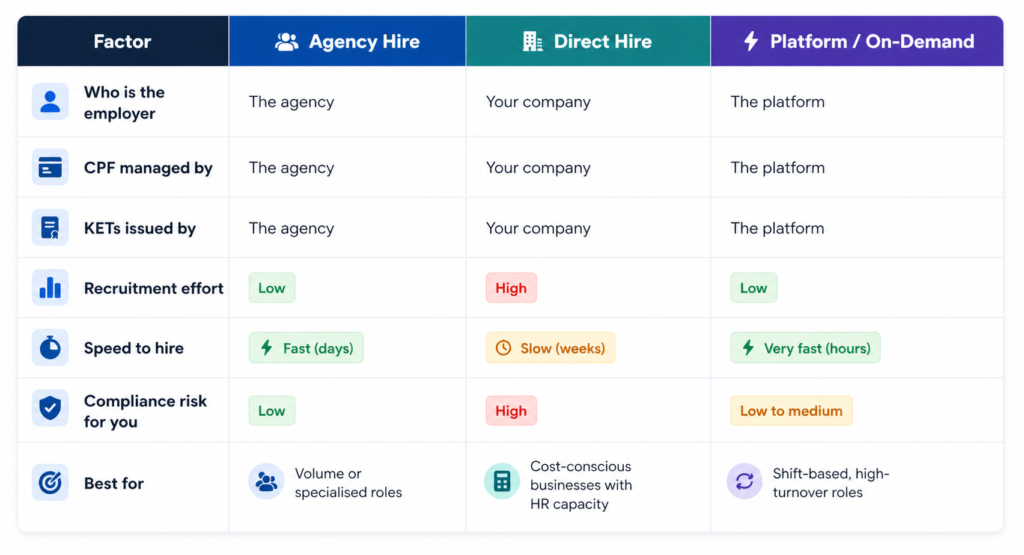
There are three distinct models for hiring temporary workers in Singapore. Understanding the differences is important because each model carries a different cost structure, compliance burden, and administrative workload.
Model 1: Partnering with a Temp Staffing Agency
This is the most common approach. The client company engages a licensed temp staffing agency, which acts as the formal employer of the placed worker. The process works as follows.
Step 1: The client company submits a staffing request to the agency, covering the job scope, duration, required experience, and agreed pay range.
Step 2: The agency sources from its pre-screened candidate pool and presents suitable profiles for the client to review and select.
Step 3: The agency issues the employment contract directly to the temp worker. All statutory obligations, including CPF contributions, itemised payslips, and Key Employment Terms, are handled by the agency.
Step 4: The worker reports to the client’s premises. Day-to-day supervision falls on the client. All HR and payroll administration remains with the agency.
Step 5: The client pays the agency an all-inclusive hourly or monthly rate, which covers the worker’s base salary plus the agency’s markup for their services, payroll costs, and administrative fees.
For businesses seeking this arrangement in Singapore, EPS Singapore Temporary Staffing service provides access to pre-screened temp workers across general and specialised roles, with full compliance and payroll management handled by EPS.
Model 2: Direct Hire of a Temporary Worker
The direct hire model means the employer takes on all responsibilities that a temp agency would otherwise handle. The employer recruits independently, issues a compliant fixed-term contract with all mandatory Key Employment Terms, registers the worker with the CPF Board, manages monthly payroll, handles leave calculations, and manages offboarding at the end of the contract.
This model appears cheaper on the surface because it avoids the agency markup. The hidden cost is time and compliance risk. Under Singapore’s Employment Act, the employer is fully responsible for every statutory obligation from day one. A single oversight, such as a missing KET item, a miscalculated CPF contribution, or failure to track the three-month leave threshold, creates real legal exposure. MOM’s employment practices framework sets out these obligations in full, and they apply equally to a temp worker on a two-month contract as they do to any permanent employee.
Model 3: On-Demand Staffing Platforms
A third model, which the market has developed significantly in recent years, involves on-demand staffing platforms and apps. These digital platforms match businesses with pre-vetted workers for shift-based or very short-duration roles. They are particularly active in F&B, events, retail, and logistics. The platform handles worker matching and, in most cases, manages the employment relationship on the host company’s behalf.
This model is worth understanding particularly in the context of Singapore’s evolving platform worker legislation, which affects how gig-based and on-demand workers are classified and what statutory benefits they are entitled to. If you are sourcing workers through a digital platform, verify that the platform manages CPF and compliance obligations and does not leave statutory duties to you as the host employer.
Side-by-Side Comparison: All Three Models
Industry-Specific Temp Staffing Needs in Singapore
Logistics and Warehousing
Singapore’s position as a global logistics and trade hub creates sustained, cyclical demand for temporary warehouse staff. Periods of peak demand, including Q4 retail surges, Chinese New Year inventory cycles, and pharmaceutical supply-chain projects, require rapid scaling that permanent headcounts cannot accommodate efficiently. Temp workers in logistics typically cover picking and packing, forklift operation, delivery assistance, and inventory management. For companies managing multiple warehouse locations, working with an agency that can mobilise workers across sites is a significant operational advantage.
Retail and F&B
Retail and F&B businesses face predictable seasonal pressure and unpredictable daily absenteeism. Both challenges are well-suited to temp staffing. Agencies serving this sector maintain pools of cashiers, sales assistants, wait staff, kitchen helpers, and barista-trained workers who can be deployed on short notice. The key consideration for F&B businesses is ensuring workers are food hygiene certified where required, and that the agency manages this verification as part of its pre-screening process.
Admin and Professional Support
Not all temp placements are blue-collar roles. There is active demand in Singapore for temporary administrative support, HR coordinators, marketing assistants, accounts clerks, and customer service staff. These roles typically arise from maternity leave coverage, project-based expansion, or transitions between permanent hires. A specialised temp agency with a PMET candidate pool is better equipped to match this level of role than a generalist agency focused on volume.
IT and Technology
Temporary and contract IT placements are a growing part of Singapore’s staffing market. Businesses engaging in system migrations, cybersecurity projects, digital transformation initiatives, or product launches often need technical specialists for defined periods. IT contractors are typically engaged on fixed-term contracts rather than short-term temp arrangements, but the hiring model through a staffing agency is the same.
Explore Staffing Services
Learn more about our staffing solutions, including Recruitment, Executive Search, Contract & Temporary Staffing, and Remote Staffing.