

Important Security Notice: Please be aware of unauthorized individuals posing as our company’s recruitment consultants. These scammers may offer fictitious roles, such as remote ‘work-from-home’ positions. We urge all applicants to remain vigilant and verify any suspicious job offers.
Home / Insights / Hiring Guide / Temporary Staffing Singapore: How It Works, Costs and MOM Compliance (2026 Guide)

Temporary Staffing Singapore: How It Works, Costs and MOM Compliance (2026 Guide)

What Is Temporary Staffing and Why Singapore Businesses Are Using It More in 2026

Temporary staffing in Singapore is a workforce strategy where businesses bring on workers for a defined period, covering project-based needs, seasonal peaks, leave gaps, or workload surges, without the long-term cost and commitment of a permanent headcount. The arrangement is brokered either through a temp agency or managed directly by the employer.

When a staffing agency is involved, it typically acts as the employer of record for the temp worker. The agency manages recruitment, payroll, and HR administration. The client company directs the worker’s daily tasks on-site. This structure protects the client from a significant portion of compliance exposure while giving them full operational flexibility.

Contract durations typically run from a few weeks to twelve months. In practice, many businesses in Singapore use rolling temporary contracts to manage fluctuating headcount without adding to their permanent establishment.

The 2026 Singapore Labour Market Context

Singapore’s labour market in 2026 is defined by a tension between stability and caution. According to MOM’s Labour Force Report 2025, Singapore’s overall employment outcomes remained positive through 2025, with nominal and real incomes rising and unemployment remaining within historical norms. At the same time, the proportion of permanent employees reached a record high of 90.8%, which signals that the market for flexible, on-demand workers has become a deliberate, strategic layer of the workforce rather than simply a fallback option.

For businesses, this matters in a specific way. A tight permanent labour market, rising payroll obligations from updated CPF contribution rates, and ongoing global trade uncertainty have collectively made temporary staffing a cost-management tool rather than just a convenience. Employers who previously hired permanent staff for project-based roles are increasingly turning to structured temp arrangements to manage risk.

Core Benefits of Temporary Staffing for Singapore Employers

Temporary staffing delivers four measurable advantages for Singapore businesses in 2026.

Workforce agility: Temp staffing lets you scale headcount up or down in response to project timelines, seasonal demand, or sudden leave coverage needs. You are not locked into a headcount that outlasts your need.

Cost control: You pay only for hours worked. You avoid the fixed costs tied to permanent employees, including annual leave accrual, sick leave coverage, and long-service entitlements. For short-duration workloads, a compliant temp arrangement will almost always cost less than a permanent hire doing the same role part-year.

Speed to deployment: A temp agency with a pre-screened candidate pool can place qualified workers within days, sometimes within 24 to 72 hours for volume roles. Permanent hiring timelines in Singapore typically run four to eight weeks for PMET roles.

Reduced hiring risk: Temp arrangements function as a structured trial period. You can evaluate a worker’s performance, team fit, and skill level before making any long-term commitment. For companies that are cautious about headcount growth, this model reduces the financial and operational cost of a poor hire.

For a more detailed comparison of temporary, contract, and permanent employment models, refer to the EPS Guide to Types of Employment in Singapore.

How Temporary Staffing Works in Singapore: Three Hiring Models

There are three distinct models for hiring temporary workers in Singapore. Understanding the differences is important because each model carries a different cost structure, compliance burden, and administrative workload.

Model 1: Partnering with a Temp Staffing Agency

This is the most common approach. The client company engages a licensed temp staffing agency, which acts as the formal employer of the placed worker. The process works as follows.

Step 1: The client company submits a staffing request to the agency, covering the job scope, duration, required experience, and agreed pay range.

Step 2: The agency sources from its pre-screened candidate pool and presents suitable profiles for the client to review and select.

Step 3: The agency issues the employment contract directly to the temp worker. All statutory obligations, including CPF contributions, itemised payslips, and Key Employment Terms, are handled by the agency.

Step 4: The worker reports to the client’s premises. Day-to-day supervision falls on the client. All HR and payroll administration remains with the agency.

Step 5: The client pays the agency an all-inclusive hourly or monthly rate, which covers the worker’s base salary plus the agency’s markup for their services, payroll costs, and administrative fees.

For businesses seeking this arrangement in Singapore, EPS Singapore Temporary Staffing service provides access to pre-screened temp workers across general and specialised roles, with full compliance and payroll management handled by EPS.

Model 2: Direct Hire of a Temporary Worker

The direct hire model means the employer takes on all responsibilities that a temp agency would otherwise handle. The employer recruits independently, issues a compliant fixed-term contract with all mandatory Key Employment Terms, registers the worker with the CPF Board, manages monthly payroll, handles leave calculations, and manages offboarding at the end of the contract.

This model appears cheaper on the surface because it avoids the agency markup. The hidden cost is time and compliance risk. Under Singapore’s Employment Act, the employer is fully responsible for every statutory obligation from day one. A single oversight, such as a missing KET item, a miscalculated CPF contribution, or failure to track the three-month leave threshold, creates real legal exposure. MOM’s employment practices framework sets out these obligations in full, and they apply equally to a temp worker on a two-month contract as they do to any permanent employee.

Model 3: On-Demand Staffing Platforms

A third model, which the market has developed significantly in recent years, involves on-demand staffing platforms and apps. These digital platforms match businesses with pre-vetted workers for shift-based or very short-duration roles. They are particularly active in F&B, events, retail, and logistics. The platform handles worker matching and, in most cases, manages the employment relationship on the host company’s behalf.

This model is worth understanding particularly in the context of Singapore’s evolving platform worker legislation, which affects how gig-based and on-demand workers are classified and what statutory benefits they are entitled to. If you are sourcing workers through a digital platform, verify that the platform manages CPF and compliance obligations and does not leave statutory duties to you as the host employer.

Side-by-Side Comparison: All Three Models
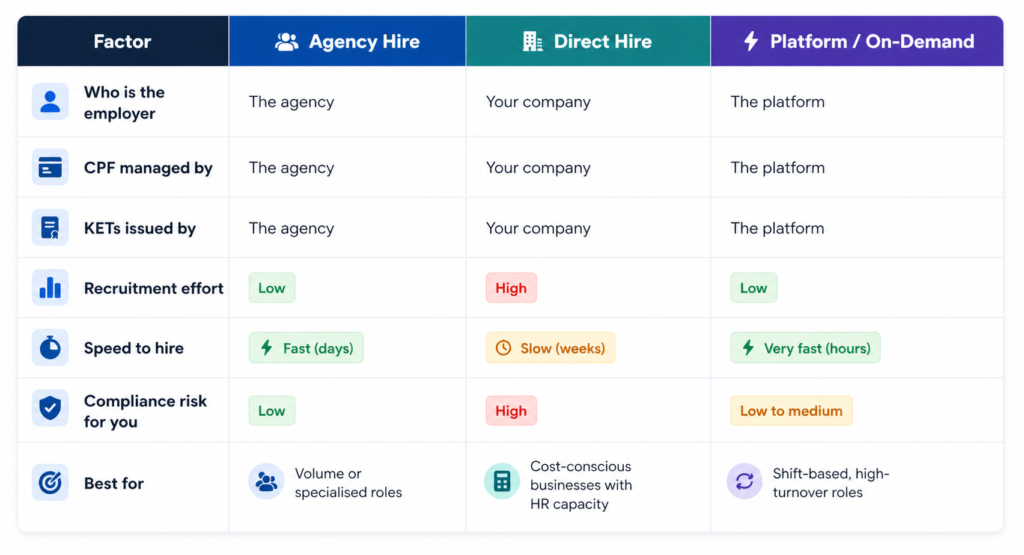
What Does Temporary Staffing Actually Cost in Singapore?

Cost is the question every operations head and HR manager asks first. The answer depends on which model you use, the role type, and how precisely you account for all-in costs rather than just the headline hourly rate.

The True Cost of Using a Temp Agency (All-In Rate Explained)

When you hire through a temp agency in Singapore, you pay an all-inclusive rate. This rate bundles together the worker’s base salary, the employer’s statutory CPF contribution, any applicable Skills Development Levy (SDL), and the agency’s service markup. You receive a single invoice. You do not separately manage CPF submissions or payroll.

Typical agency markups in Singapore range from 15% to 30% above the worker’s base salary for general roles. Specialised or technical roles, such as IT support contractors or safety officers, will sit at the higher end or beyond. The all-in rate is higher than what you would pay if you directly employed the same worker, but it is not a meaningful comparison unless you account for the full cost of direct hire.

The All-In Cost of Direct Hiring a Temp Worker

When you hire a temp worker directly, the true employer cost is not just the salary. You are responsible for:

Employer CPF contribution: For workers under 55, the employer contributes 17% of ordinary wages. Refer to the MOM and CPF Compliance section below for full rates and eligibility details.

Skills Development Levy (SDL): All employers in Singapore must contribute SDL for every employee working in Singapore, including temporary and foreign workers. The levy is 0.25% of monthly wages, with a minimum of SGD 2 and a maximum of SGD 11.25 per employee per month, as detailed in the Singapore employer payroll obligations guide.

Payroll administration: You bear the cost of payroll processing, timesheet management, CPF EZPay submissions, and payslip issuance.

Recruitment cost: Job posting fees, time spent screening, and interviewing.

Compliance cost: HR time spent drafting compliant contracts, managing KETs, and tracking leave accruals.

Sample Cost Comparison: Agency vs Direct Hire for a 3-Month Project

Scenario: You need one warehouse coordinator for 3 months at a base salary of SGD 2,200 per month.

Direct hire total cost breakdown: Base salary: SGD 2,200 x 3 = SGD 6,600. Employer CPF at 17%: SGD 374 x 3 = SGD 1,122. SDL: approximately SGD 5.50 x 3 = SGD 16.50. Pro-rated annual leave (if employed past 3 months, leave accrues from day one): SGD 169 estimated. Payroll admin + job ad + time cost: SGD 400 to 600 estimated. Total direct hire cost: approximately SGD 8,500.

Agency hire estimated cost: All-in hourly rate for this salary band: approximately SGD 16 to SGD 18 per hour. Hours in 3 months (assuming 26 working days/month, 8 hours/day): approximately 624 hours. Total: SGD 9,984 to SGD 11,232.

The agency model costs more on paper. But it eliminates recruitment time, compliance risk, payroll administration, and any liability for an oversight in CPF or leave calculations. For one worker over a short period, the difference is manageable. For 10 or 20 workers, the complexity and risk of direct hire compounds quickly.

MOM and CPF Compliance: What Every Employer Must Know

Compliance is where temporary staffing arrangements create the most exposure for Singapore businesses that are not prepared. The Employment Act makes no meaningful distinction between permanent and temporary workers when it comes to statutory obligations. If you employ someone under a contract of service, the Act applies.

The Employment Act and Your Temp Workers

Singapore’s Employment Act is the primary law governing employment relationships in Singapore, covering all employees except domestic workers, seafarers, and statutory board employees. As confirmed by the ICLG Singapore Employment and Labour Law Report 2026, employers must issue a written record of Key Employment Terms to all employees covered under the Act who are employed for 14 days or more. This obligation starts on day one of engagement and does not have an exemption for temporary workers.

Key Employment Terms are the mandatory written employment details that every employer in Singapore must provide to employees covered under the Employment Act. They must be issued within 14 days of the start of employment. According to MOM’s official KETs guidance, KETs must cover at minimum the employer’s full name, the employee’s name, job title, description of main duties, start date, duration of employment, working hours, salary period, and basic rate of pay.

For temporary staff, the KETs document must clearly state the fixed-term nature of the contract, including the end date. Failure to issue KETs is an administrative breach under the Employment Act and can complicate any dispute about pay, working hours, or contract terms.

A practical note: your employment contract can serve as the KET document provided it contains all required fields. You do not need a separate standalone KETs form if your contract is complete.

CPF Contributions for Temporary Workers in 2026

One of the most common misunderstandings among businesses hiring temp workers in Singapore is the assumption that CPF obligations do not apply to short-term or part-time arrangements. This is incorrect. CPF Board confirms that CPF contributions are payable for any Singapore Citizen or Permanent Resident employee earning more than SGD 50 per month, regardless of whether they are employed on a full-time, part-time, temporary, contract, or casual basis.

The employer contribution rate for workers under 55 is 17% of ordinary wages. The employee contributes 20%. Total contributions for this age group sit at 37%. Both the employer and employee shares must be submitted to CPF Board by the 14th of the following month.

From 1 January 2026, CPF contribution rates for workers aged above 55 to 65 increased, with the employer contribution for the 55 to 60 age group rising from 15.5% to 16%. The ordinary wage ceiling also increased from SGD 7,400 to SGD 8,000, meaning employers must now calculate contributions on up to SGD 8,000 of monthly wages. If you employ senior temp workers in this age bracket, your payroll cost calculations need to reflect these updated rates.

For the full contribution rate table applicable to your workers, use the CPF Board’s official contribution rate guide.

The 3-Month Continuous Service Rule

A temporary employment relationship that runs past three consecutive months triggers annual leave entitlements under the Employment Act. Specifically, a temp worker who has worked continuously for at least three months is entitled to pro-rated annual leave from the first day of their engagement, not from the point the three-month threshold is crossed.

This means a worker on a contract running from October to February has accrued annual leave for the full five-month period by the time February arrives. Any company managing its own direct temp workforce needs a system for tracking contract start dates and calculating leave liability before it becomes a compliance issue at offboarding.

The Misclassification Risk: Contractor vs Employee

The most costly compliance failure in temporary staffing is worker misclassification. Some businesses attempt to engage temp workers as independent contractors on a contract for service, avoiding CPF contributions and Employment Act obligations in the process. This approach carries significant risk.

Under Singapore law, the worker’s legal status as an employee or a contractor is determined by the substance of the working arrangement, not the label on the contract. If the company controls what the worker does, when they do it, and how they do it, that person is likely an employee under a contract of service, regardless of what the agreement says. MOM has intensified enforcement of misclassification in recent years. As Singapore’s 2026 employment law framework confirms, a true contractor operates under a contract for service, is in a position to profit or lose from the work, and is not subject to the same level of control as an employee. The boundary matters: misclassification exposes employers to back-payment of CPF contributions, penalties, and reputational risk.

The safest path is straightforward. If the person works on your premises, under your direction, on your schedule, treat them as an employee and engage a licensed agency or manage full compliance internally.

How to Choose the Right Temp Staffing Agency in Singapore

The choice of agency matters beyond price. The wrong agency can expose your business to compliance gaps, deliver poorly matched candidates, or create administrative friction.

General Agency vs Specialised Agency

A general temp agency carries a broad, volume-focused candidate database suitable for production line roles, janitorial positions, event support, or basic retail work. Turnaround is fast and cost is lower. The trade-off is that matching depth is limited for anything beyond basic qualifications.

A specialised temp agency builds its database around a defined sector or skill set. For companies needing temporary IT support engineers, compliance officers, finance professionals, or healthcare staff, a specialist agency screens for credentials and technical fit that a generalist will not have the infrastructure to verify.

The right choice depends on your role requirements. For high-volume, lower-skill placements, a generalist is efficient. For project-critical or technically demanding roles, the cost of a poor match from a generalist exceeds the premium of a specialist.

Key Questions to Ask Before You Sign

Before engaging a temp agency in Singapore, ask the following:

Is the agency licensed by MOM? Operating with an unlicensed Employment Agency exposes both the agency and the client to penalties. Verify the agency’s EA licence number on the MOM registry.

Who is the legal employer of record? Confirm in writing that the agency takes on the employer role and all statutory obligations, including CPF, KETs, payslips, and leave administration.

What is included in the all-in rate? Ask for a written breakdown. Confirm whether CPF employer contribution, SDL, insurance, and administration fees are already included or will be added separately.

What is the agency’s replacement policy? If a placed worker leaves within the first few weeks, understand whether a replacement is provided and on what timeline.

Does the agency have experience in your sector? Ask for reference clients and ask specifically about roles similar to yours.

Industry-Specific Temp Staffing Needs in Singapore

Logistics and Warehousing

Singapore’s position as a global logistics and trade hub creates sustained, cyclical demand for temporary warehouse staff. Periods of peak demand, including Q4 retail surges, Chinese New Year inventory cycles, and pharmaceutical supply-chain projects, require rapid scaling that permanent headcounts cannot accommodate efficiently. Temp workers in logistics typically cover picking and packing, forklift operation, delivery assistance, and inventory management. For companies managing multiple warehouse locations, working with an agency that can mobilise workers across sites is a significant operational advantage.

Retail and F&B

Retail and F&B businesses face predictable seasonal pressure and unpredictable daily absenteeism. Both challenges are well-suited to temp staffing. Agencies serving this sector maintain pools of cashiers, sales assistants, wait staff, kitchen helpers, and barista-trained workers who can be deployed on short notice. The key consideration for F&B businesses is ensuring workers are food hygiene certified where required, and that the agency manages this verification as part of its pre-screening process.

Admin and Professional Support

Not all temp placements are blue-collar roles. There is active demand in Singapore for temporary administrative support, HR coordinators, marketing assistants, accounts clerks, and customer service staff. These roles typically arise from maternity leave coverage, project-based expansion, or transitions between permanent hires. A specialised temp agency with a PMET candidate pool is better equipped to match this level of role than a generalist agency focused on volume.

IT and Technology

Temporary and contract IT placements are a growing part of Singapore’s staffing market. Businesses engaging in system migrations, cybersecurity projects, digital transformation initiatives, or product launches often need technical specialists for defined periods. IT contractors are typically engaged on fixed-term contracts rather than short-term temp arrangements, but the hiring model through a staffing agency is the same.

Frequently Asked Questions About Temporary Staffing in Singapore

Do temporary workers get CPF contributions in Singapore?

Yes. CPF contributions are mandatory for any Singapore Citizen or Permanent Resident employee earning more than SGD 50 per month, regardless of whether they are employed on a temporary, part-time, or casual basis. When you hire through an agency, the agency manages CPF. When you hire directly, you are responsible.

How much does a temp staffing agency charge in Singapore?

Agency fees vary by role type. For general and blue-collar roles, the all-in markup above base salary typically falls between 15% and 25%. For specialised or PMET roles, the markup can be 25% to 35% or higher. Always request a written breakdown of what is included in the quoted rate before signing.

What is the employer CPF contribution rate for temp workers in 2026?

For Singapore Citizens and PRs (third year onwards) under 55 years of age, the employer contribution rate is 17% of ordinary wages, with the Ordinary Wage ceiling set at SGD 8,000 per month from 1 January 2026. Rates differ for workers aged above 55. Refer to the CPF Board’s current contribution rate tables for the full breakdown.

Can I hire a temp worker without using an agency in Singapore?

Yes. You can hire directly by posting a job, selecting a candidate, and managing the contract yourself. However, you become the legal employer and are responsible for all obligations under the Employment Act and CPF Act, including issuing compliant KETs within 14 days, submitting CPF contributions by the 14th of the following month, and managing leave accruals.

How long can a temporary contract last in Singapore?

There is no statutory cap on the duration of a fixed-term contract in Singapore. However, if a temp worker is employed continuously past three months, annual leave entitlements begin to accrue from the first day of employment, and the full protections of the Employment Act apply.

What is the minimum notice period for temp staff?

Notice periods for employees employed for less than 26 weeks are a minimum of one day. For employees employed between 26 weeks and less than two years, the minimum notice period is one week. These are statutory minimums. Your contract can specify longer periods. Refer to MOM’s employment practices guidance for the full notice period schedule.

What are Key Employment Terms (KETs) and do they apply to temp workers?

KETs are the mandatory written employment details that employers must provide to all employees covered under the Employment Act who are employed for 14 days or more. They apply equally to permanent and temporary workers. Employers must issue KETs within 14 days of the start of employment.

What is the difference between a temp worker and a contract worker?

Temporary workers are typically engaged for short periods, often a few weeks to a few months, to cover specific gaps or seasonal demand. Contract workers are usually engaged for defined longer durations, often six to twelve months, tied to a specific project or business need. Both are engaged under a contract of service and are covered by the Employment Act.

Hire Temp Staff in Singapore with EPS Singapore

EPS Singapore is a MOM-licensed staffing and recruitment agency with over 30 years of experience placing workers across Singapore. We operate dedicated divisions for both general temp staffing and specialised temp placements, covering industries including logistics, manufacturing, retail, administration, healthcare, and IT.

When you engage EPS for temporary staffing, we act as the employer of record for all placed workers. We handle contract issuance, CPF contributions, itemised payslips, leave administration, and offboarding, so your team stays focused on running the operation, not managing compliance.

Whether you need one temp worker for a two-week project or fifty workers for a peak-season operation, EPS has the infrastructure and the candidate network to mobilise quickly.

To find out more about our temporary staffing service or to speak with a consultant about your current needs, visit our Temporary Staffing service page or contact us directly.

Ready to Hire Top Talent?

Schedule a free consultation to discuss your hiring needs. We'll create a customized recruitment strategy that saves you time and brings you quality candidates.

Scroll to Top